
By Alia Smith
with Alan Lipton
Self-Defense for Teen Girls and Women: Why a STEM and STEAM Nonprofit Is Offering This Training
Many science, tech, engineering, and math (STEM) fields, like physics and computer engineering, historically have been male-dominated. Tides are turning, however, with young women enrolling in these academic programs and entering STEM professions in greater numbers. These girls and women are actively disproving the pervasive myth that STEM proficiency is gender-based. While this is an exciting change to witness, it comes with a swath of new risks and situations for which girls and women need to be prepared, including when to use verbal and physical self-defense.
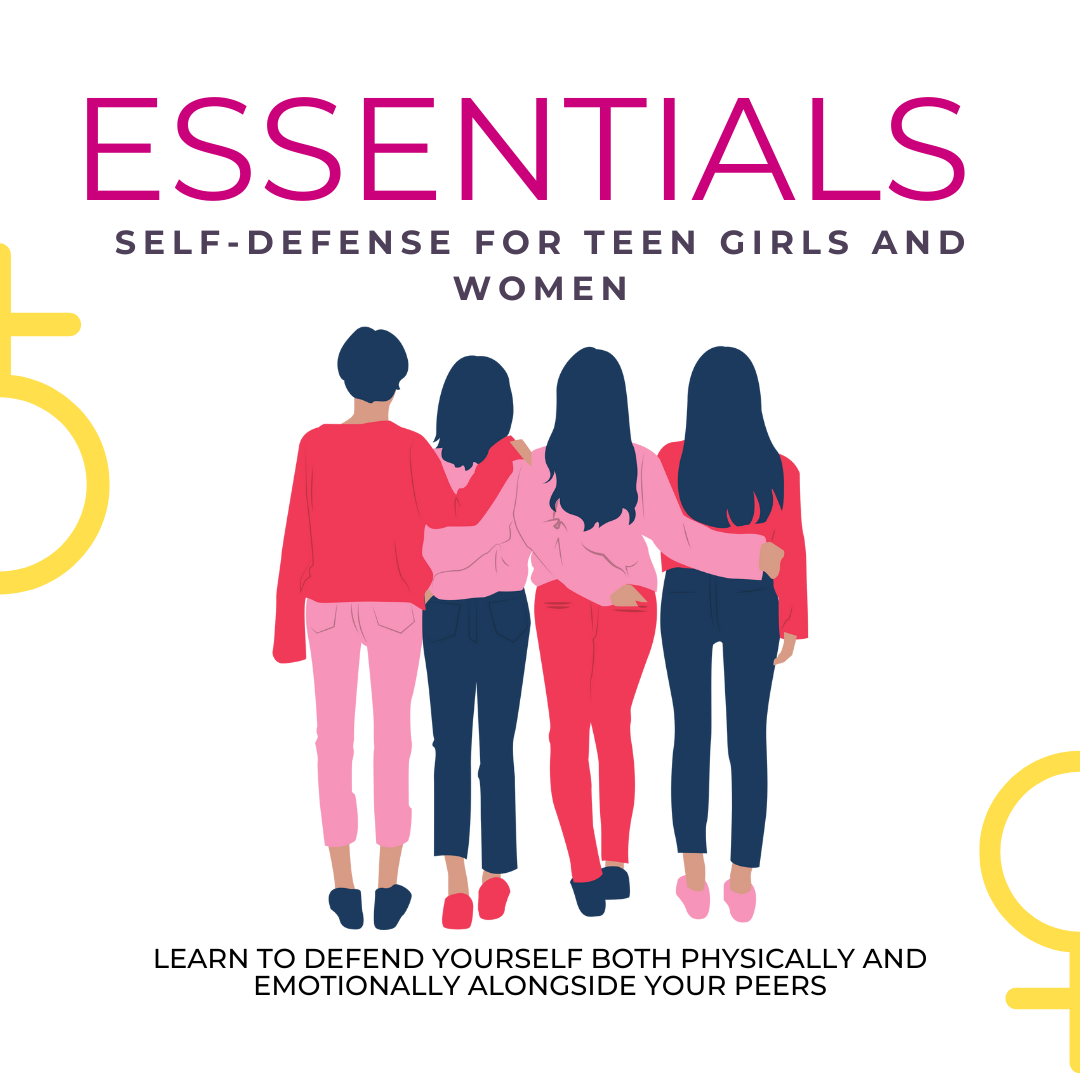
Register Now: Essentials Self-Defense for Women and Teens Age 16+
Real Concerns About Personal Safety
As girls and women enter university and professional settings, they are exposed to new situations and environments. College campuses have been shown to be hotspots for sexual and gender-based harassment.
- According to a 2018 study from the National Academies of Sciences, 20 percent of female science majors, 27 percent of female engineering majors, and 47 percent of female medical science majors reported experiencing gender-based harassment, including hostile attitudes, crude behavior, unwanted sexual attention, and sexual coercion.
- In 2020, the National Library of Medicine found that sexual violence was reported more frequently in gender-balanced STEM fields like biological sciences and chemistry than in male-dominated STEM fields like computer science and engineering. Researchers associate this increase in sexual violence with a form of backlash. This statistic indicates that the fields in which you might anticipate being safest– where there are similar numbers of men and women– are often less safe than the fields in which you might be one of few women.
- Rape, Abuse, Incest National Network reported in 2024 that sexual violence is the most prevalent crime on college campuses, with 18- to 24-year-old women at the highest risk. However, according to the U.S. Department of Education, the risk begins even earlier: “Roughly 135,600 harassment incidents were reported in K-12 schools in 2015-2016 – more than 40 percent of those incidents were sex-based, and 63 percent of those targeted were girls.”
Only the girls and women who report the crimes can be counted in these statistics. The rates are likely higher than we are able to quantify because these incidents are under reported. These alarming statistics paint a picture of girls and women facing a lifetime of threats to their safety. We are, however, determined to help them move safely and confidently into the male-dominated college majors and professions of their choice.
Self-Defense for Teen Girls and Women in a STEM and STEAM Program?
Pretty Brainy has always upheld the mission of empowering middle- and high-school girls to explore and embrace STEAM subjects (science, technology, engineering, art + design, math). Through our after-school programs, mentorships with STEAM professionals, and a variety of service learning initiatives, we have sought to provide girls with the tools needed for overcoming challenges to learning, excelling, and being successful in STEAM fields.
Despite equipping girls with these lifelong skills to build their minds, they are still entering situations in which their safety is jeopardized. Girls must be and feel safe. We see a clear and direct relationship between a girl’s physical safety and her ability to thrive in STEAM. Our job of empowering girls as thinkers, problem-solvers, leaders, and innovators would be incomplete without addressing their physical safety.
Every girl and woman is entitled to equitable, top-quality education, including the integrity of being able to attend school, pursue her goals, and live her life without the age-old threat of being at greater risk for sexual assault because she is a girl or a woman. Our sense of responsibility toward ensuring this fundamental right lies at the heart of Pretty Brainy’s Essentials Self-Defense Training.
We will empower girls with the skills to stand up for themselves, establish hard boundaries, deescalate and remove themselves from unsafe situations, and physically defend themselves if needed.
Author Bio

Alia Smith is the programming associate for Pretty Brainy. She recently graduated from Colorado State University with a master’s degree in Ecosystem Science and Sustainability. For her thesis, Alia studied the use of citizen/community science to study pollinator decline in National Parks. She is passionate about science communication and connecting people with science.
References
“Campus Sexual Violence: Statistics.” RAINN. Accessed August 9, 2024. https://rainn.org/statistics/campus-sexual-violence.
Johnson, Paula A., S. E. Widnall, and Frazier F. Benya. Sexual harassment of women: Climate, culture, and consequences in academic sciences, engineering, and medicine. Washington, DC: The National Academies Press, 2018.
Reidy, Dennis E., Laura F. Salazar, Elizabeth Baumler, Leila Wood, and Leah E. Daigle, “Sexual Violence against Women in STEM: A Test of Backlash Theory among Undergraduate Women,” Journal of Interpersonal Violence 38, no. 13–14 (February 20, 2023): 8357–76. https://doi.org/10.1177/08862605231155124.
“Sexual Misconduct in Schools.” AAUW, June 18, 2020. https://www.aauw.org/issues/education/sexual-misconduct/.



 are registered US trademarks. Copyright © 2008 - Pretty Brainy, Inc. All rights reserved.